Abstract Submission is now closed!
ONSITE INFORMATION
For further information regarding speaker ready room onsite hours and location, please visit the onsite information page:
Presenter Guidelines
These guidelines were created to ensure a consistent, high-quality presentation experience for all WCB 2026 presenters and delegates.
Presenter Quick Guide (At-a-Glance)
Oral Presentations
- Standard Oral Abstract Presentation: 8 min + 3 min Q&A
- Leading Speaker Presentation: 12 min + 3 min Q&A
- Format: PowerPoint 16:9 landscape
- Upload or changes until 3 hours before session in the speaker ready room:Location: West 210Hours of Operation:• July 11: 10:00–20:00• July 12: 08:00–17:30• July 13: 08:00–17:30• July 14: 08:00–17:30• July 15: 08:00–15:00
- Download the Official Presentation Template
Poster Presentations
- New posters displayed daily (July 12, 13, 14, 15)
- Install: 09:00–10:00
- Presenting: 10:30 – 11:30. All poster presenters are required to be present at their assigned poster boards to engage with attendees and answer questions.
- Viewing: 10:00–17:00 (July 12, 13, 14) 10:00-13:30 (July 15)
- Remove: 17:00–18:15 (July 12, 13, 14) 13:30 – 15:00 (July 15)
- Posters not collected by 18:15 = discarded (July 12, 13, 14) 15:00 = discarded (July 15)
Poster Printing link: https://colourtime.myprintdesk.net/DSF/SmartStore.aspx#!/CategoryHome/31
1. General Presenter Expectations
All presenters must ensure that their content is:
- Scientifically rigorous and methodologically transparent
- Presented clearly for a multidisciplinary engineering audience
- Free from commercial logos and promotional material
- Accessible, readable, and unbiased
2. Oral Presentation Guidelines
2.1 Duration
Standard Oral Abstract
- 8 minutes presenting
- 3 minutes Q&A
Leading Speaker
- 12 minutes presenting
- 3 minutes Q&A
2.2 Slide Formatting Requirements
- PowerPoint (.ppt/.pptx), 16:9 widescreen, landscape
- Minimum font size: 14–16 pt
- High contrast color schemes
- Avoid excessive red text or lines
- Use visuals over text: diagrams, plots, simulations
- Disclosure slide is mandatory
- Final take home message slide is mandatory
Tip: Test your slides on a large screen before arrival.
2.3 Engineering Communication Best Practices
- Start with a clear research question or objective
- Visualize methods with schematics, workflows, or pipelines
- Use readable, minimal equations
- Ensure axes, units, and legends are fully labeled
- Summarize limitations / validation
- End with key contributions
2.4 Submission, Reuploading & Templates
Submission
- Submission deadline: 3 hours before your session
Reuploading
- Allowed until 3 hours before your session through the onsite Speaker Ready Room
Onsite Editing
- Permitted in the Speaker Ready Room
- Presentations run from conference laptops only
Template
- Download the Official Presentation Template
2.5 Onsite Oral Logistics
- Check into Speaker Ready Room 3 hours before presenting
- Speaker Ready Room HoursLocation: West 210Hours of Operation:• July 11: 10:00–20:00• July 12: 08:00–17:30• July 13: 08:00–17:30• July 14: 08:00–17:30• July 15: 08:00–15:00
- Test all media (videos, animations, simulations)
- Arrive in session room 15 minutes early
- Meet Session Chair(s)
- Familiarize yourself with microphone and pointer operation
2.6 What Happens After You Submit Your Slides
- AV team will verify your file
- The last uploaded version will be loaded onto the session laptop
- Edits only allowed in Speaker Ready Room – no session room submissions or edits allowed
- Bring a USB backup
2.7 Common Mistakes to Avoid (Oral Presentations)
- Portrait slide orientation
- Text smaller than 14 pt
- Videos or simulations not embedded
- Overly dense figures or unreadable images
- Logos or promotional content
- Failure to test slides onsite
- Exceeding your presentation time
2.8 Social Media and Recording Guidelines
Review the Social Media and Recording Sharing Policies.
3. Poster Presentation Guidelines
3.1 Poster Size
Your poster dimensions can have a maximum width of 42 inches and a maximum height of 42 inches.
3.2 Poster Content Requirements
Required components:
- Poster Number
- Poster title
- Authors and affiliations
- Research question / problem statement
- Methods (experiment setup, simulation workflows, computational models)
- Results (plots, heatmaps, contour maps, model outputs)
- Conclusions & relevance
- Contact information
3.3 Poster Design Recommendations
- Title: 72–100 pt
- Section headers: 36–48 pt
- Body text: 24–32 pt
- Use high-resolution images and plots
- Label all axes, units, and legends clearly
- Ensure figures are readable from 1–2 meters
- Use color-blind accessible palettes
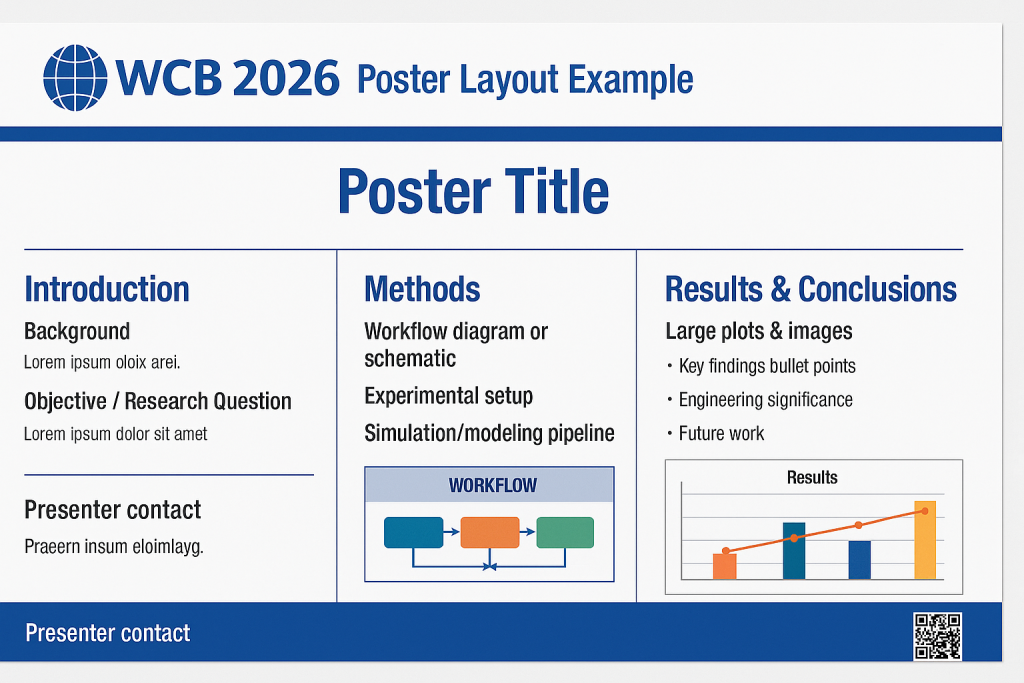
3.4 Poster Layout Example (Text-Based Structure)
Header (full width)
- Poster Title (large)
- Author Names & Affiliations
Left Column – Introduction
- Background
- Objective / Research Question
- Motivation
Middle Column – Methods
- Workflow diagram or schematic
- Experimental setup
- Simulation/modeling pipeline
- Key parameters
Right Column – Results & Conclusions
- Large plots & images
- Key findings bullet points
- Engineering significance
- Future work
Footer
- Presenter contact
- Optional QR code
3.5 Poster Layout Visual Reference
3.6 Poster Installation & Removal
Daily Poster Turnover
A new set of posters will be displayed each day:
July 12, 13, 14, and 15
Installation
09:00–10:00 on your assigned poster day
Removal
17:00–18:15 on July 12, 13 and 14
13:30 – 15:00 on July 15
Important
Any posters left after 18:00 (July 12, 13 and 14) or 16:00 (July 15) will be discarded.
Storage is not available.
3.7 Poster Viewing Schedule
| Poster Day | Date | Viewing Time | Presenters in Attendance |
|---|---|---|---|
| Day 1 | July 12, 2026 | 10:00 – 17:00 | 10:30 – 11:30 |
| Day 2 | July 13, 2026 | 10:00 – 17:00 | 10:30 – 11:30 |
| Day 3 | July 14, 2026 | 10:00 – 17:00 | 10:30 – 11:30 |
| Day 4 | July 15, 2026 | 10:00 – 13:30 | 10:30 – 11:30 |
Presenter discussion times will be announced individually.
3.8 Poster Printing Information
Poster Printing link: https://colourtime.myprintdesk.net/DSF/SmartStore.aspx#!/CategoryHome/31
3.9 Common Mistakes to Avoid (Poster Presentations)
- Printing at incorrect size
- Low-resolution figures
- Text too small to read from 1–2 meters
- Missing units, labels, or legends
- Forgetting contact details
- Installing posters after 10:00
- Not removing posters by 18:00 (posters discarded)
4. Accessibility & Visual Clarity
Applies to all presenters:
- Avoid red–green combinations
- Ensure strong text/background contrast
- Use distinct line styles and markers
- Verbally describe complex visuals
- Ensure readability from across the room
5. Professional Conduct Expectations
Presenters are expected to:
- Respect time limits
- Maintain professionalism during Q&A
- Be available during poster discussions
- Ensure content is appropriate for an international audience
Support Contact
For any questions, please contact: wcb2026-abstracts@icsevents.com.
June 11, 2025
Launch Abstract Submission and WCB Travel and Student Bursary Awards Application
December 5, 2025 (23:59 PST)
Abstract Submission Deadline
December 5, 2025 (23:59 PST)
Application Deadline for WCB Travel and Student Bursary Awards
February 25, 2026
Notification of Abstract Acceptance/Rejection
March 6, 2026
WCB Travel and Student Bursary Award Notifications
March 27, 2026 (23:59 PST)
Abstract Presentation Acceptance Deadline - Early Registration Deadline
May 8, 2026
Presenting Author Registration Deadline
July 11 - 15, 2026
Congress
Abstract Submission Tracks
Biomechanics Education, Knowledge Translation and Outreach
Studies on any and all aspects of knowledge translation, education and commercialization. Scholarship on community engaged research.
Cardiovascular/Cardiorespiratory Biomechanics
Studies on mechanics of blood, circulation, respiration, including applied research on interventional devices addressing disease.
Sub Tracks:
Methods, Models and Applications
Materials and Devices
Cell Biomechanics
Theoretical and experimental studies of the mechanics of proteins and nucleic acids, molecular mechanisms of stress transmission, mechanosensing and mechanotransduction in cells.
Sub Tracks:
Methods and Models
Mechanobiology
Clinical Biomechanics
Studies on neuromuscular control (neuromechanics), whole body mechanics and movement, in clinical contexts or examining questions related to injury or disease. Studies that are treatment and/or translational in focus.
Comparative Biomechanics
Studies on the mechanics of non human organisms. Studies can include overlap with biomimetics.
Emerging Areas
Studies on artificial intelligence, machine learning, biomimicry and bionics as applied in biomechanics. Studies involving in silico trials, novel stochastic approaches and data science application in biomechanics.
Human Motion and Performance
Studies on gait, biomechanics of human performance and motion, and applied research including biomechanics of sport.
Sub Tracks:
Balance, Posture and Control
Locomotion/Gait
Sports
Imaging and Biomedical Devices
Studies on development or application of imaging techniques. Biomedical devices including internal, interventional and wearables.
Sub Tracks:
Imaging Fundamentals and Applied Research
Artificial Organs, Devices
Assistive Technologies
Injury Biomechanics
Studies on mechanics of traumatic injury, model development, protection mechanics for mitigating injury and injury prevention.
Micro/Biofluidics
Studies examining microfluidics, nanofluidics, and molecules/cells including novel techniques for diagnostic, medical, biological, pharmaceutical, environmental, and chemical applications.
Sub Tracks:
In Silico Models and Simulation
Experiments
Molecular Biomechanics
Studies on examining mechanical effects on proteins and nucleic acids, and the understanding of the molecular mechanisms of stress transmission, mechanosensing and mechanotransduction in living cells.
Musculoskeletal Biomechanics
Studies involving bones, cartilage, skeletal muscles, tendons, ligaments and the form, support, movement and stability of humans or animals. Studies emphasizing fundamental mechanisms and questions.
Sub Tracks:
Tissues
Joints and Motion
Methods, Models and Applications
Organ and Tissue Biomechanics
Studies focusing on any of mechanical models, characterization of tissues or organs embracing both experimental and in silico approaches.
Orthopaedic Biomechanics
Studies examining mechanical effects on musculoskeletal tissues during growth, function and repair. Studies examining interventional devices and instrumentation. Studies emphasizing pathology, diagnosis, and treatment including instrumentation.
Sub Tracks:
Trauma and Repair
Sports Medicine
Lower Extremities
Upper Extremities
Spine
Rehabilitation Biomechanics and Human Factors
Studies on rehabilitation, prosthetic devices and related instrumentation. Studies on occupational health with an emphasis on mechanical factors and/or occupational hygiene.
Sub Tracks:
Rehabilitation
Occupational Biomechanics
Tissue Engineering
Studies merging engineering with biological science and medical science toward to creating functional tissue substitutes.
Sub Tracks:
Mechanobiology
Methods, Models and Applications
Abstract Submission Guidelines
- Word Limit (not including title and authors): 350 words
- Title Word Limit: 30 words
- Tables/Images: Either one (1) table or one (1) image in GIF, JPEG, JPG or PNG format of a minimum of 300 dpi and 100% size. Higher resolution is strongly preferred.
- Structure of Abstract (Mandatory)
- Introduction – Mandatory to complete
- Methods – Mandatory to complete
- Results – Mandatory to complete
- Discussion – Mandatory to complete
- Acknowledgements – Not mandatory to complete
- References – Not mandatory to complete
- Abstracts may include work that is ongoing, provided that preliminary results or initial findings are available at the time of submission.
- Submission Fee: No submission fee
- Presenting Author Limit: No more than 2 presentations (oral or poster or invited presentation) per abstract presenter.
- Number of Co-authors Limit: No
- AI Disclaimer: If you used AI technology to assist in creating content for your presentation or writing your abstract, you will need to provide the name of the tool, its application, and how you used it during the abstract submission process.
Manuscript Submission Opportunity
The top-rated abstracts will be invited to submit a full manuscript for consideration in special issues of the Journal of Biomechanics and the Clinical Biomechanics Journal (maximum 1–2 abstracts per track).
During the abstract submission process, authors may indicate whether they are interested in submitting a manuscript based on their abstract for one of these special issues and select their preferred journal. Authors selected for this opportunity will be required to submit their full paper by March 31, 2026.
This option offers an excellent pathway to expand your conference contribution into a peer-reviewed publication. We encourage invited authors to watch for upcoming communications with further instructions.
Definition: Plagiarism encompasses any of the following:
- Direct: intentionally submitting another person’s words or ideas verbatim as one’s own
- Self-plagiarism: submitting work that has been previously published or presented
- Mosaic plagiarism: stringing together portions of text from other sources
- Lack of attribution: failing to appropriately identify and cite sources for language or ideas that are incorporated.
Screening
WCB screens all abstracts using anti-plagiarism software. Abstracts identified as having high levels of potentially plagiarized content will be evaluated by WCB staff and appropriate actions taken.
Penalties
Penalties for plagiarism may include rejection of abstract and/or author(s) banned from making presentations at future WCB, ESB, CSB or ASB Conferences.
Plagiarisms Policy